Sunday, 4 April 2021

Khajuraho Diary

 T. S. Burt was a British engineer in the rolls of the Company Bahadur. In 1838, during his travels in central India, he was told about the wonders of this place called `Khajraho’. His palanquin bearer conveyed the location of this place, hidden deep in the jungles. Khajuraho had been lost to mankind for more than five centuries after the fall of the Chandellas. That is the underlying story of the rediscovery.

A short drive from nearby Panna brings us to the UNESCO World Heritage site on an early March afternoon. The sun is beginning to stamp its authority.

*******

There is a near-complete lack of visitors, other than a few locals. The rows of outlets that cater to a largely `firang’ crowd round the year look desultory. The pandemic continues to have a telling effect. We enter the Western group of temples at the break of dawn with two objectives; to use the `golden hour’ for photographs and to avoid the blazing sun. Its a surreal experience to have the entire complex to yourself ; not a soul in site, other than the occasional security personnel.


******

Opinions of experts indicate that the temples of Khajuraho may have been built on mounds / islands within a large lake. This is borne out by the fact that none of the temples have perimeter walls for protection; also, they stand on high plinths. In his travel writings, Ibn Batuta mentioned that there was a large lake in Khajuraho, dotted with temples. Today, the water body has been replaced with manicured ASI gardens. Its surreal to imagine how this complex would have looked like within a lake, and how on earth were they constructed ten centuries ago.

******

On the road in India, the English language morphs into a separate beast that’d hardly be recognizable in Old Blighty. Your lateral thinking ability is put to test to make sense of what are written at various places. Sample these…..

 It presumably started out as an effort to create a retreat made of bamboo. It ended up being a mere `treat, of the bamboori variety. 


The `coolar’ is a mere typo, and an easy one to decipher. I wonder, however, at the thought process of the Captain behind a couple of others. Bianca Castafiore wouldn’t recognize this `Margrita’ (Item 11). In Item #7, orange juice is the only warhead of Citrus Attack. The other ingredients, presumably, are antidotes / defence options for the intestine.

******

The Western group of temples is more touristy. This is where most visitors focus. It is easy to miss out on a few other gems that lie beyond this complex. These are not so well organized, though ASI is in charge. The Southern and Eastern groups have unique architecture that include Vamana (maintaining a form similar to Kandariya Mahadeva), Chaturbhuj and Brahma temples. You need an effort to locate these amidst residential colonies. But they are worth it.


And then there are the remnants of Chausath Yogini, just outside the precincts of Western Group. It establishes the tribal origins of the Chandellas and their pagan rituals. The place is eerie.


******

Twenty kilometres out of Khajuraho, hidden among forests, lies the delightful Raneh Falls. The forest guard informs that most visitors to Khajuraho give it a miss. The existence of nearby dams hardly provides a water flow for the falls, except during monsoon. The rock formations around the falls take your breath away. Five separate layers of igneous rocks give it the stunning variety of colours; green dolomite, black basalt, brown quartz, red jasper and pink granite.


Ken Gharial Sanctuary is located a bit further down the river. With a pair of decent binoculars, you can observe the languid movements of these fish-eaters in the clear blue waters of Ken.


******


Sunday, 17 November 2019

Benaras Diary


9:30 a.m.. Varanasi Junction. You can’t set a foot on Platform No.1 without either trampling on a fellow human or on fresh poo. Its Dev Deepawali. Millions across India and from abroad are converging at the ghats of the Ganges. This occurs each year fifteen days after Diwali on a full moon night of Kartik Purnima. Gods descend from heaven on this day to bathe in the Ganges; hence, the chaos.

As festivals go, this is as big as it gets at Benaras. All the 80+ ghats are lit up with diyas, the sky is smattered with firecrackers rarely seen, sound and noise pollution levels touch new highs and brisk commerce is undertaken by vendors in temporary stalls. The boatmen make their annual killings on this evening. I overheard one of them quoting a lakh to an inquiring customer for a one hour ride.

Yet it all merges to produce a spectacle worthy of the gods.


******

Breakfast. The mandatory fare is all about kachori-sabji, hot jalebis and malaiyo. A bit more about that last item. Milk is left out in the open at night to catch the dew. A sprinkling of cardamom, saffron and sugar is followed by vigorous churning to generate a frothy output. This is then topped with pistachio crumbs. The end result transcends you to heaven.
Ram Bhandar, in Thatheri Bazar, is supposed to set the gold standard for kachori-sabji-jalebi. As a non-regular, please factor a half hour wait and serious jostling before your turn arrives for the goodies. The stuff is good, but there’s a better, lesser known option around. You need to move away from the ghats to get a taste of the real deal. This is a hole-in-the-wall outlet at Chetmani Chauraha. The place sets the Nadia Comaneci (Montreal edition) standard. Its the mix of black grams and paneer in the sabji that does the trick. As you munch your jalebi, the crackle can be heard for miles around. 


******

The `bhakts’ may continue to holler. Their worthy opponents may shout themselves hoarse. India has only one religion, one opium for its people. Its called cricket.


******

Rahul catches me at Chet Ghat. His English is fluent. He sizes me up, and says I must be from Canada. Canada?! I get the drift of his observation and deduction thereafter. Chet Ghat houses a mutt of Sachchidananda Maharaj. The Maharaj has huge following of Indian origin from Canada. Rahul concludes that I must be one of them. He escorts foreign tourists around the city. He’s disappointed that I’m not a newbie to the place. But his commentary on the history of the fort at Chet Ghat, the battle with Warren Hastings, is a gem.


******

There’s something about anchored boats on a shoreline. It brings a sense of serenity, a lightness of being. It contributes as much to making Benaras what it is as any other theme.


******

Across the river, clinging to the walls of Ramnagar Fort, there’s Shivprasad Lassi Bhandar. They serve lassi of a semi-solid variety that you need to eat with a spoon; not drink. Default toppings comprise malai and rabri. A large `khullar’ of the stuff, a proper meal by itself, sets you back by forty bucks. Its a steep increase from the twenty rupees I shelled out six years ago. The post-consumption bliss remains unaltered.    

******

Babu is a Benaras-bred Bong from Bangali-tola. His dad was a fitter in the mechanical section of Indian Railways at the local DLW. The youngest child of his family, Babu peddles `babaji ka prasad’. He stocks stuff of high quality. Unfortunately, he himself has succumbed to irretrievable depths from his own addiction.

******

At Babua Pandey Ghat, you can’t miss the bright signs of Lucy’s Heritage Cafe. It essentially serves vegan fare and offers a stunning view of the ghats. A few months ago, the river overflowed. The resultant floods wreaked havoc on the city. Lucy’s was practically under water for some time. It took two months for the delightful cafe to be restored and for operations to resume.


******

The `Swachh Bharat’ mission was a five year drive launched in 2014 to tidy up India and to bring in a culture of cleanliness. The project served its purpose for the government’s headline management. It may also have created awareness. At ground level, however, old habits are deeply embedded and die hard. On an early morning visit to Vishwanath Temple, I stood in a long queue behind a dhoti-clad, lota-wallah in his forties. He maintained a torrent of spit on the walls of the temple as the queue progressed. All in the name of faith and Bholeynath!

******

8:30 a.m.. Clear skies. The morning stroll along the ghats begins. But its soon brought to a halt by the strains of a `bansuri’. I follow the sound. Perched on a ledge above Tulsi Ghat is a young flautist, constructing an impeccable Ahir Bhairav. Its evident that he’s professionally trained. A unique act, in a matchless setting, for an audience of one. A surprise awaits you around every corner at Benaras.


******


*******

Monday, 19 February 2018

Rajasthan : An alternative discovery

Billboards, hoardings, posters, menus at restaurants. In an increasingly consumerist India screaming for custom, outdoor advertising provides meaningful insights on the lay of the land and its people.


This piece is a filtered output of observations on the road in Rajasthan in February 2018. Some require explanations and are accompanied by commentaries.


The official hop-on, hop-off tour bus near Fateh Sagar, Udaipur; a seenful sight!


From the menu of an upmarket fusion restaurant at Jaipur. I didn’t have the temerity to enquire whether this was a rhetorical statement, a worldly observation or a diktat to the contemplating drinker. Please note that the key differentiation lies in `Tobasco’.


Spreading discounted peace to the world.........peace by peace.


This is a tragic story. What commenced as an enterprise in pastry excellence ended as a herd of goats, considering the two signboards of Sona.


 HIS influence now extends to far-flung Udaipur.


Self explanatory.


 How do you land a USP that enables you to grab tourist traffic around Pichola Lake? In Octopussy lies the answer!


This is an excerpt from the highest rated eatery at Chittorgarh across all travel sites. The Chinese offering benumbs, kyasooner rather than later. 

Monday, 17 July 2017

Monsoon Diary : Meghalaya


The mad caper across East Khasi Hills


‘Its 4:35, its dark outside, its been raining for about eleven years’, runs a popular British crib about the weather. The wettest place in UK (Snowdonia, Wales) records annual precipitation of 3,000 mm. I am headed to a place that reports four times the annual rainfall at Snowdonia, at Meghalaya, in peak monsoon. I ascribe no reason for this madness.

******

Shillong, the capital of Meghalaya, has an airport that’s an hour’s drive from the city. A solitary daily ATR flight reaches this airport from Kolkata at an inconvenient hour. In contrast, Guwahati airport in bordering Assam is a lovely three hour drive from Shillong. Fourteen daily flights connect Kolkata and Guwahati. As a logical traveller, it is easy to be trapped in the chase for that single flight to Shillong if you are not aware of the better alternative.
 
******

A weekend arrival ensures bumper-to-bumper traffic on GS Road; travellers from Guwahati and Kolkata hoping to escape the heat in the plains. I apply a time-tested formula to cover or avoid recommended tourist hot spots in the city. The presence of shops offering egg rolls, chilly chicken with `fried-ice’ and phuchkas is a sure-fire screamer to by-pass. Ward’s Lake and Lady Hydari Park are filtered out through this test.


******

I need a drop at the busy Police Bazar. The cab driver is a smart, young local. His affinity for Arsenal FC is manifest in the bright red beanie on his crown. Born and brought up in Shillong, he’s only visited Gangtok (Sikkim) and Palanpur (Gujarat) outside his state. A school excursion took him to the former. An uninteresting attempt at diamond polishing brought Palanpur in his map. He’s dismayed at the slush and population overload that engulf Shillong now.

******

Crinoline Falls is touted as a tourist attraction in Shillong. In their infinite wisdom, the powers that be in the local administration built a modern swimming pool under the falls. I reach the gates to find the place closed. A crisp notice at the gate reads `Falls closed for repair of swimming pool’. Go figure!


******

The village of Langkawet lies 57 kms south of Shillong. I have a scheduled home-stay at the village. Google map advises that I should make it by road in an hour and forty four minutes. I leave Shillong with a manageable cloud cover after breakfast. By the time I take a left at the fork at Laitlyngkot, visibility is down to a few metres as thick clouds move in. The only respite from poor visibility is in the form of pelting rain. The lack of a road divider on NH 206 doesn’t help in the drive. I reach Langkawet in a little over three and a half hours. Over the next few days I realise that the area offers two forms of weather this time of the year......near-zero visibility among thick cloud cover, and relentless downpour when visibility improves. Add the wind chill, and each drop of rain is a sharp spike that you grit and bear. The degree of wetness at Langkawet is evidenced in all tree trunks around you bearing layers of slippery moss. The toilet roll in the loo is irreparably soggy. A leech sways in the air in an attempt to land on your wrist.
Lacking reading material, the guest register at the home-stay is my only option. I have a hunch that there would be few takers from Kolkata for this place. This does not conform to ticking fourteen tourist hotspots in nine hours. A flip-through of the latest 107 visitors throws up just three groups from Kolkata. The list includes an actor-turned-director from Mumbai, who was a regular in the Basu Chatterjee / Hrishikesh Mukherjee comedies in the 70s.


******


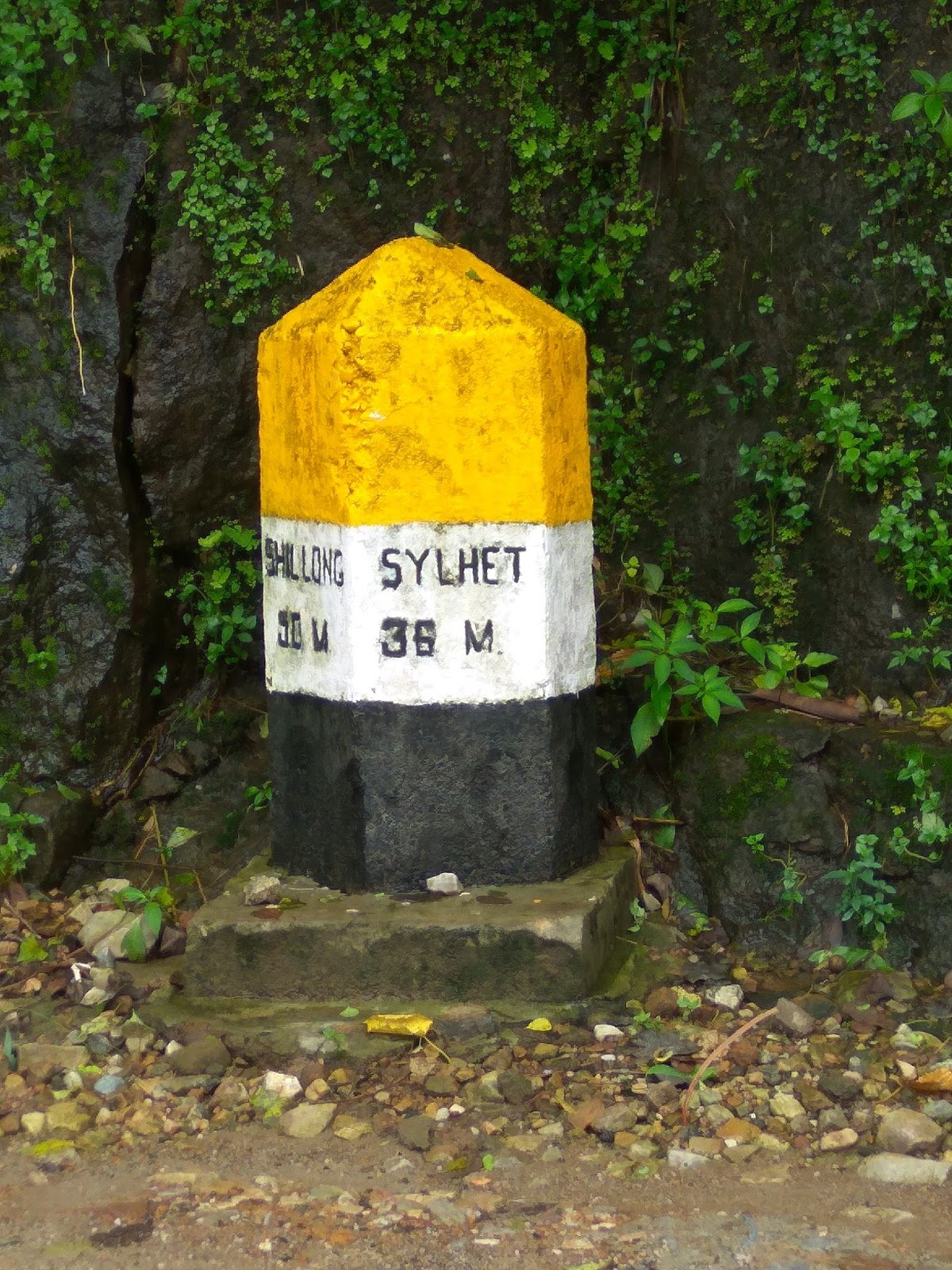
I brave the rains and hit the road (NH 206 again) to Dawki at the Bangladesh border next morning. The weather improves as I roll down the hills adjacent to the magnificent Umngot river. Beyond the river lie the unending plains of Sylhet, where my forefathers once lived. Almost all surrounding villages in the Khasi Hills provide uninterrupted views of this vast plain. Heavy rains in this part of Meghalaya drain out to these plains in Bangladesh, causing inevitable floods on the other side of the boundary. The shop owners at Dawki are comfortable speaking Bengali, albeit with a Sylheti diction that someone from Bengal would struggle to decipher. Two incidents stand out at Dawki. My travel companion maintains his mobile on auto-roaming mode. On reaching Dawki, his phone logs on to RobiTel. His regular service provider in India informs him that INR 100 has been debited to his account for `international roaming’. The second involves the GPS tracker installed in our car. I keep receiving frantic messages on my mobile from my car hire company: `We observe that you are approaching Bangladesh border. Please note that you are not permitted to cross the border of India in this car.’ I can visualise the concerned faces in the GPS tracking room, as they imagine the car engine being promptly installed in an unregistered motor boat in Bangladesh after I do the needful.


******


In 2003 Discover India magazine declared Mawlynnong as the cleanest village in Asia. Life for the 500 odd residents in this quaint village hasn’t been the same since. The eyes of `civilisation’ are now firmly focused on Mawlynnong. Every day, carloads of yelping tourists descend at the centre of Mawlynnong, their diesel vehicles belching smoke and the honking in the narrow village lanes creating a ruckus. Only a matter of time before the dreaded egg roll and fried-ice / chilly chicken counters commence business here. Corporate intervention is evident. Solar panelled streetlights (you can’t miss the large IDFC logo on each panel) provide clean energy to the village. I wonder if a similar initiative has been undertaken by IDFC in any other lesser known village in the state. Entry of motor vehicles in the village must be stopped immediately. Visitors should be required to cover Mawlynnong on foot or on bicycles; a practice that’s well established in other fragile environments like Hoi An, Vietnam.

******

I don’t know what to make of the hullabaloo in the press on the debate over beef ban in the hills. Pork and chicken are default options for non-vegetarians in all the eateries. None of them feature beef in the menus.

******

I usually maintain a stock of emergency munchies on the road. This is not necessitated in Meghalaya. At every other bend on the hills, you can stop at these shacks and have your fill of fresh pineapples and plums; of quality and at prices that we only dream of in the cities.

******

The cafe culture is in overdrive and rocking at Shillong. The established pan-India names have their presence, but are not high in the pecking order. Two standalone cafes are exceptional.

The cantonment at Shillong, just south of the city, is the Eastern Command headquarters of Indian Air Force. Within this area lies the pristine ML05 Cafe. `ML 05’ is the popular registration you will see on the number plates of vehicles here; the theme of the cafe, therefore, has everything to do with driving. A Royal Enfield Bullet hangs strategically at the centre. The hot chocolate with marshmallows is perfect to wash down a thin crust pizza topped with a tonne of fresh mozzarella.


Within the city, Dylan’s Cafe opened last year as a tribute to the 2016 Nobel winner. Robert Zimmerman is strewn all over.....in posters, hanging vinyls, books, memorabilia and background music. A closer look at some of the records show that there are others included here apart from Dylan. Rare LPs of Purna Das Baul and Calcutta Youth Choir / Salil Chowdhury also find place here. Lest I forget, the Americano and the lamb spare ribs are delectable.


******

Nongpoh lies midway between Shillong and Guwahati. I make a pit stop at a shack for a last fill of pineapple. Rosalyn Wallang, prop. and of indeterminable age, offers the needful. She sells pineapples, plums and potted plants that she grows in a nursery across the highway. She’s the chatty type. We get conversing. She has stuff for her nursery to be picked up at Paltan Bazar in Guwahati. Would I give her a lift to the city? I agree. Over the next fifty kilometres, she expounds at random on her life’s philosophy......

`I run the family business. I have a husband (the only time I find mention of a man in her life) and two sons. The sons go to the village school. There’s no point aspiring for the sons’ admissions to a high end institution at Shillong. Schools don’t matter. At the end of the day one faces the same Board exam paper, irrespective of which school you attend. Money is required for living, but cannot be the sole pursuit. I take time off to educate my fellow villagers on financial literacy, the importance of savings and how to open bank accounts. I encourage my young friends in the village to undertake apprenticeship in my business and then help in setting up their own enterprises. Last week, I sold a pineapple that weighed eight kilograms. It fetched a premium! Some day, you should visit my mom’s village in West Khasi Hills. Its more beautiful than where you’ve been. Let me know, and I can guide you’.


Her words resonate as I board the flight.  

Monday, 13 March 2017

A Delta Recce

March is not particularly recommended as a good time to visit Sunderbans. We prepared for sultry weather. It rained incessantly instead. The accompanying wind chill forced us to extract blankets on the boat that was our home for three days. And when the rain stopped, as periodically it did, the habitants emerged from the forests to make their hurried forage. The result was some exquisite sightings.


*******
The sareng was of middle age. Living in this inhospitable terrain has wizened him beyond his years. We were discussing the issue of earnings and savings. Manoeuvring the helm, the sareng informed that his personal loss from the Rose Valley scam was forty thousand rupees. How could he fall for the bait? Was it the obvious expectation of inflated returns? He responded in the affirmative, and added that there was one more compelling factor; that of emotional blackmail. The sareng’s doom was initiated by his aunt, a local primary school teacher doubling as a chit fund agent. Her line of reasoning was compulsive. `This is the opportunity of a lifetime. Would I, as a respectable teacher and your family member, nudge you to any proposition that’s fraught with risk?’ Similar stories abound in all families in the area.     
******
On the flip side, the inadequacy of formal banking channels is disturbing. The state owned and private banks are conspicuous by their near-absence. Local co-operative banks struggle to bridge the resultant gap, bound by their own shortcomings. This is a cash-based society. The vision of a cashless India that most of the country hotly pursues doesn’t hold water. Internet is rarely available. The local banks do not have the wherewithal to handle more than a few lakhs of cash daily. The villagers thus prefer holding cash at home to cover exigencies. A nationalised bank operates a boat that serves as a mobile bank in the delta. But that’s insufficient for the four million odd that inhabit the islands.
******
Kalitala Khal is a narrow creek that separates the village of Shamsher Nagar from dense tiger land. In low tide, one can almost waddle across the creek. This story goes back in time before secure wire nets were erected on the forest side to prevent tigers from straying into the village. Based on villagers’ complaints, Forest Department officials set up a trap to capture a straying tiger. The makeshift trap contained a live goat which, when tugged, would cause the trapdoor to drop and rein in the tiger. As night progressed, the officials waited in darkness to hear the sound of the trapdoor falling. The goat helpfully maintained its bleating. And then they heard the anticipated clang! They rushed to the cage, keeping a wary eye on surroundings to ensure there wasn’t more than one tiger in the vicinity. They peeped inside to find a man cowering in a corner of the cage, exploring options to escape. He had attempted stealing the goat. Consider the risks that he evaluated before embarking on his mission..... the risk of being mauled by a tiger. He circumvented that risk. Then there was the bigger risk of a sound thrashing from the villagers if he was found in the cage; which he couldn’t overcome.


********
Drinking water is an issue. You will need to stack up as much of those 25 litre cans from mainland as you can when you are living or travelling in these parts. It is ironic when you find yourself surrounded by water in the delta. Gives you a first-hand feel of what the Ancient Mariner experienced. Consumption of river water guarantees acute diarrhoea or jaundice, or both.
On a related note, a loaf of bread requires you to access mainland. But a wide range of fish and prawn invariably appear on your plate.
******
The old man doesn’t read or write, but is finely attuned with nature. He was sitting and staring at the flowing water on the riverbank. `Do you see how clear the water looks? What does that signify?’ he inquired of one of my fellow travellers. And proceeded to answer by himself. `This will be a great season for hilsa. The clear water is created by precipitation resultant from the combined flapping of gills of a shoal as it moves upstream to lay eggs’.
*******
Eight years ago Cyclone Aila hit Sunderbans and left in its wake a trail of horrific destruction. One of the worst impacts was on the arable land. The cyclone waves that swept over left the land too rich in saline content and, thus, uncultivable. Pre-Aila, Sunderbans was a big exporter of watermelon. You could have seen barges loaded with watermelon plying the rivers for shipment to the cities. This was a key cash commodity. We meet a farmer at Shamsher Nagar who takes us on a tour of his fields. A rat snake hears our footfall, rears its head and seeks hasty cover in a crack. In one corner of the field, another attempt is being made to cure the land and grow the melons again. Similar efforts in the last few years had to be aborted. The watermelons grew and then inexplicably burst before ripening. Hope springs eternal.  


******
The State Government is considering developing Dhamakhali as an entry point to Sunderbans for tourists. The reasons are twofold. First, it will ease the congestion of traffic at other popular points of embarkation like Godkhali and Sandeshkhali. Secondly, the discerning tourist is keen on `the river experience’ in the world’s largest estuarine delta. He expects to spend minimum time on road and maximum on water. In terms of distance from Kolkata, Dhamakhali fulfils this expectation. Situated 67 km from Kolkata, the distance on road is shorter than that from the city to Godkhali or Sandeshkhali. But there’s this minor issue. The government insists on the added bonanza of a lunar module ride with the river experience. The 67 kms journey takes two hours and more. The last stretch of 12 kms from Agarhati to Dhamakhali doesn’t have a road. It has the outline of what once would have been a road through brick kilns in marshland. This outline shall also disappear once monsoon arrives. Will it be another instance of a road not taken? 


******